
Airsoft Shotguns: Best Picks and How They Work
Airsoft shotguns fire three BBs per trigger pull, making them devastating in CQB. The best models, how tri-shot works, and what they cost.
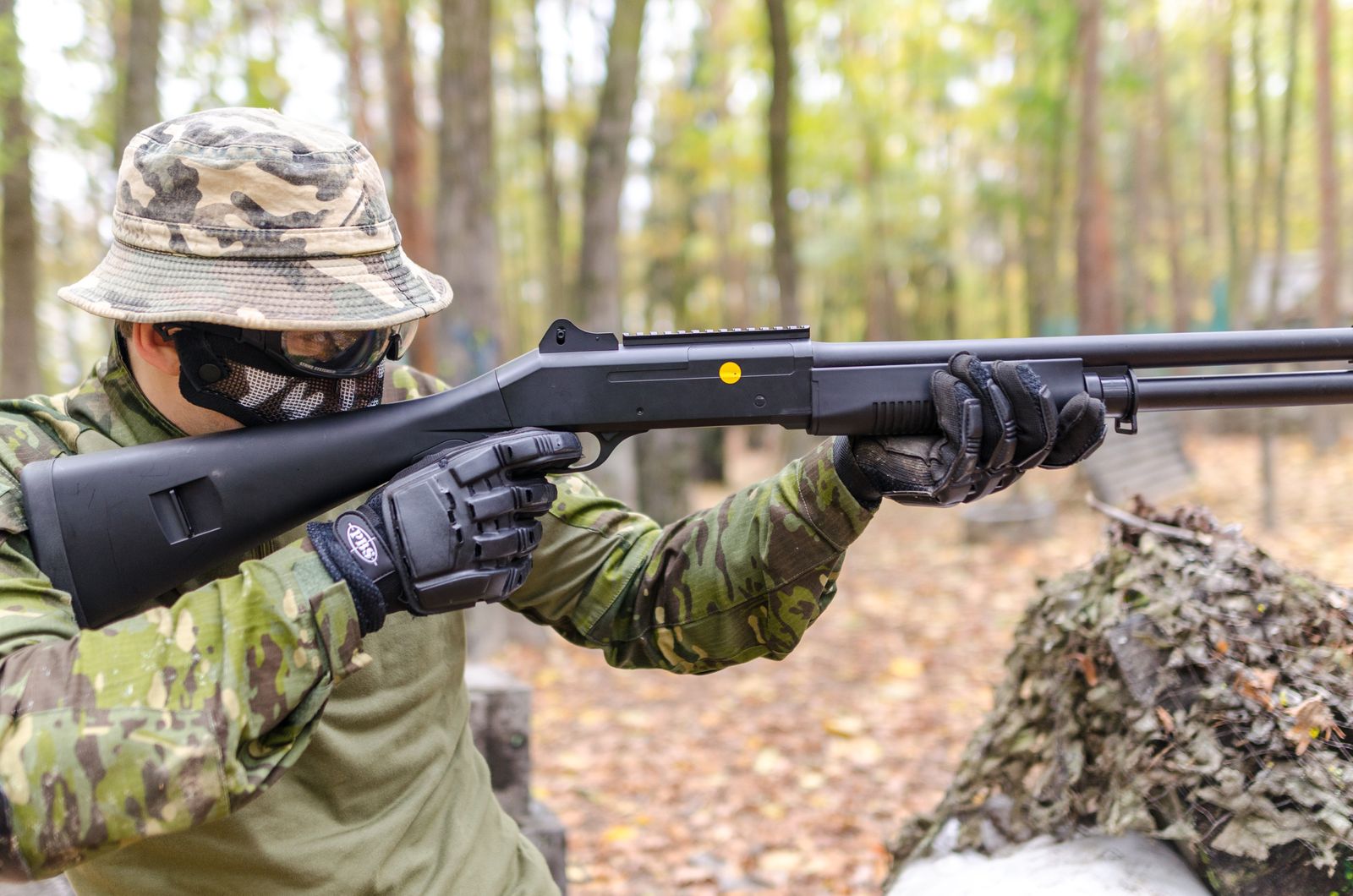
Airsoft shotguns are the most underrated guns in the sport. Most fire three BBs per trigger pull, which means one shot covers a spread that a rifle needs a burst to match — and in a tight indoor corridor, that is decisive.
They are also the most fun gun on any field, which is a legitimate reason to own one.
Quick picks
| Category | Pick | Typical range |
|---|---|---|
| Best overall | Tokyo Marui M870 Tactical | $300–420 |
| Best budget | CYMA CM.350 / CM.351 | $70–130 |
| Best electric | Tokyo Marui SGR-12 | $350–450 |
| Best shell-ejecting | APS CAM870 | $250–350 |
| Best for CQB | Any short-barrel tri-shot | $70–200 |
How airsoft shotguns work
Three mechanisms, and the difference matters:
Spring pump-action
You pump the forend before each shot, which compresses the spring. Cheap, utterly reliable, no battery or gas, and unaffected by weather. The overwhelming majority of airsoft shotguns work this way — including nearly every one under $150.
Gas
Uses green gas or CO2 to launch the BBs, still cycled by pumping. More power and a satisfying report, with the usual gas trade-offs in cold weather.
Electric (AEG shotgun)
Battery-powered and capable of semi or full auto while still firing multiple BBs per shot. Rare and expensive, but devastating indoors.
What “tri-shot” means
Most airsoft shotguns fire three BBs simultaneously from three separate inner barrels. This is the entire appeal — you get a genuine spread, so a near-miss with a rifle becomes a hit with a shotgun. Some models fire six per pull.
Note that tri-shot guns are chronographed differently. Fields usually measure a single BB’s velocity, and because energy is split across three, a shotgun’s per-BB FPS often reads lower than a rifle’s while hitting considerably harder overall.
Best airsoft shotgun: Tokyo Marui M870
Tokyo Marui’s M870 is the one every other shotgun is measured against. Gas-powered, tri-shot, superbly built, and it handles like the real Remington it replicates. The pump action is satisfying in a way cheaper guns never quite manage.
Watch out for: it is expensive, gas-dependent, and shell capacity means frequent reloading.
Best budget shotgun: CYMA CM.350 series
This is where most people should start, and it is genuinely remarkable value. A spring-powered tri-shot pump gun for well under $150 that needs no gas, no battery, and almost no maintenance. Full metal and polymer variants exist, plus a shorter “breacher” version for indoor play.
Why it wins: the performance gap between this and the Tokyo Marui is far smaller than the price gap. For a gun you will bring out for indoor games, it is the sensible buy.
Watch out for: the stock hop-up is basic. Range is shorter than a rifle regardless — that is the nature of the gun.
Best shell-ejecting: APS CAM870
Fires from CO2-charged shells that eject when you pump, exactly like the real thing. Nothing else on a field looks as good.
Watch out for: shells are expensive, need individual charging, and you will lose them in the grass. Buy a shell pouch and accept that this is a gun you own for the experience rather than the efficiency.
Are airsoft shotguns any good in a game?
In the right game, they are excellent. Honest assessment:
| Strengths | Weaknesses |
|---|---|
| Multiple BBs per shot — high hit probability | Short effective range |
| Devastating in CQB and indoors | Slow rate of fire |
| No battery or gas needed (spring models) | Low ammo capacity |
| Extremely reliable | Outclassed in open outdoor fields |
| Cheap to buy and run | Reloading is slow |
Where they shine: indoor CQB, close-quarters objective games, building clearing, and as a secondary you bring out for specific games.
Where they struggle: open outdoor fields where engagements happen at 150 feet and you cannot close the distance.
Buying advice
- Start with a spring tri-shot. They are cheap, reliable and cover 90% of what makes shotguns fun. Move to gas later if you want more.
- Check shell capacity and reload speed. Some hold 30 rounds internally, others use individual shells. The latter is more realistic and considerably slower.
- Short barrels for indoors. A full-length shotgun is awkward in a corridor.
- Confirm your field allows tri-shot. Nearly all do, but a handful have specific rules about multi-BB guns, especially indoors.
New to airsoft? Start with what is airsoft, or see our best airsoft guns guide if you need a primary first.
Shell-fed vs magazine-fed: the thing to check first
Airsoft shotguns feed in two completely different ways, and it changes how the gun plays more than the power source does.
| Internal magazine | Individual shells | |
|---|---|---|
| Capacity | Typically 30 rounds, often more | Usually 30 BBs per shell, 3–6 shells |
| Reload speed | Fast — swap the magazine | Slow and deliberate |
| Realism | Low | High — shells eject |
| Losing parts | Nothing to lose | Shells vanish in grass |
| Ongoing cost | None | Replacement shells |
Shell-ejecting guns like the APS CAM870 are magnificent and slow. Magazine-fed guns are practical. Most players who buy shell-fed keep them for specific games rather than as a primary — which is fine, provided that is what you intended.
If you go shell-fed, buy a shell pouch and count your shells before and after every game. Brass-coloured shells in autumn leaf litter are effectively camouflaged.
Barrel length and inner barrels
Tri-shot shotguns run three inner barrels, and their length is set by the outer barrel. Shorter “breacher” models are far easier indoors, which is where shotguns are strongest anyway.
The trade-off is smaller than on a rifle. Because energy is split across three BBs, shotguns are not competing on range regardless — you lose less by going short than you would with an M4. For a gun you bring out for CQB, take the shorter one.
Getting the most out of one
Use the spread deliberately
The three BBs leave in a loose triangle that widens with distance. At close range that is close to a guaranteed hit on a torso. At 100 feet the pattern is wide enough that you may put one BB on target and two into scenery — which still counts, but wastes the advantage.
Play the corners
A shotgun rewards ambush positions and doorways over open ground. If you find yourself trading shots across a field, you have brought the wrong gun to that fight.
Pump properly
A half-pump is the most common cause of a dead trigger on a spring shotgun. Short-stroking under pressure happens to everyone; pump fully and deliberately.
Mind your BB weight
Because energy is divided three ways, heavy BBs suit shotguns poorly — the hop-up has less energy per BB to work with. Stick to 0.25g and let the spread do the work. See our BB weight guide.
Chronograph rules for tri-shot guns
This confuses new shotgun owners regularly. Fields normally chronograph a single BB, and because a tri-shot splits its energy across three, the per-BB reading comes out lower than a rifle’s — often well under the site limit.
Some fields measure total energy instead, or apply a separate shotgun limit. A few require you to fire single-BB shells for the chrono. None of this is a problem; it just means you should ask rather than assume your reading means what you think it means.
Maintenance
Spring pump shotguns are among the most reliable things in airsoft — there is very little to go wrong. What does need attention:
- Keep the shell tubes clean. Grit in a shell scratches the BBs on the way out and wears the seals.
- Silicone oil on gas models, occasionally, exactly as with gas magazines — see our green gas guide.
- Check the pump rails for grit after muddy games.
- Do not dry-fire repeatedly. Same reasoning as any spring system.
Shotgun or SMG for CQB?
Both are strong indoors and they fail differently.
| Shotgun | SMG | |
|---|---|---|
| Hit probability per shot | Very high — 3 BBs | Lower per shot |
| Rate of fire | Slow, manual | Full auto |
| Ammo capacity | Low | High |
| Reload under pressure | Poor | Good |
| Reliability | Excellent | Good |
| Cost of entry | From $70 | From $110 |
The shotgun wins the first exchange and loses a prolonged one. If you are pushing rooms and can dictate when contact happens, that suits you. If you expect to be pinned and trading fire, take the SMG.
Plenty of players carry a shotgun as a secondary primary — brought out for specific indoor games rather than run every weekend. At $70–130 for a spring tri-shot, that is an easy thing to justify.
Frequently asked questions
Are airsoft shotguns good?
Yes, in close quarters. Most fire three BBs per trigger pull, which gives a much higher hit probability than a single-BB rifle shot at short range. They are outclassed on open outdoor fields where range matters more.
How many BBs does an airsoft shotgun shoot?
Most fire three BBs per trigger pull from three inner barrels, hence the term tri-shot. Some models fire six, and a few fire a single BB.
Are airsoft shotguns spring or gas?
Most are spring-powered pump action, which makes them cheap and extremely reliable. Gas versions offer more power and a stronger pump feel, and rare electric models can fire in semi or full auto.
What is the best budget airsoft shotgun?
The CYMA CM.350 series is the standard budget recommendation — a spring tri-shot pump gun well under $150 that requires no gas or battery and needs very little maintenance.
How far can an airsoft shotgun shoot?
Effective range is typically 60 to 120 feet, shorter than an AEG. The spread that makes shotguns effective up close is the same thing that limits them at distance.