Tokyo Marui Samurai Edge Standard M9 Style Gas Blowback Biohazard
- Pistol
- SKU GP-TM-Biohazard
Opens an Amazon search — we do not track Amazon prices or stock, so check them there.
Price comparison
| Retailer | In stock | Price | Difference | Link |
|---|---|---|---|---|
| Evike.com Best price | Yes | $199.99 | — | View deal for $199.99 at Evike.com (opens in a new tab) |
Prices last checked 12 hours ago. Always confirm on the retailer site before buying.
Price history
- Lowest tracked $199.99
- Highest tracked $199.99
- Price changes recorded 5
Based only on prices we have observed since tracking began.
About this airsoft gun
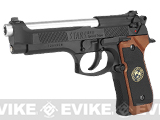
The Tokyo Marui Samurai Edge is a licensed Biohazard replica that also happens to be a working sidearm. This is the Standard Model — the plain S.T.A.R.S. issue version, not one of the named-character customs — and underneath the markings it is Marui’s M9-pattern gas blowback pistol, semi-automatic, running on gas carried in the magazine.
What the Tokyo Marui Samurai Edge actually is
In the games, the Samurai Edge is a Beretta 92F reworked by a local gunsmith for the S.T.A.R.S. team. That is what Marui has reproduced here: a Beretta-pattern frame and slide wearing the custom-shop detailing that separates the gun from a plain M9 — the reshaped beavertail, the custom hammer, and the licensed Samurai Edge and S.T.A.R.S. branding the design is known for. Check the listing photos for exactly how the version you are looking at is marked.
The rest is standard Tokyo Marui pistol construction. Marui builds its gas blowback pistols around lightweight polymer slides and frames rather than metal, with an adjustable hop-up unit and a gas magazine that doubles as the propellant reservoir and lives in the grip. That construction is part of why Marui pistols cycle so briskly on low-pressure gas, and it is also the first thing people complain about, because a plastic slide does not feel like a real one in the hand.
Two things this is not. It is not the full-auto Samurai Edge — that pattern belongs to other variants and other manufacturers, and this one is semi-auto only. And it is not a metal-bodied gun dressed in Biohazard livery; the appeal here is the licensing and the way Marui’s gas system shoots, not the heft.
How a Marui gas blowback behaves
A gas blowback pistol stores its propellant in the magazine and uses part of each shot to drive the slide back, which chambers the next BB and gives you the recoil pulse and the cycling slide. That is the whole appeal, and it is also the whole running cost: gas, magazines, and a bit of maintenance. If you are choosing between platforms for the first time, our AEG vs GBB vs HPA guide lays out where each one wins.
A few things are specific to Marui and worth knowing before you order.
- Gas type. Marui designs its pistols around the low-pressure Japanese domestic gas, and green gas runs at a higher pressure than that. Plenty of people run green gas in Marui pistols anyway, but it puts more stress on a polymer slide and shortens the life of the internals. If you go that route, expect to replace wear parts sooner.
- Power. Japanese-market guns are built to Japan’s domestic power limit, which sits below what many fields in the US and UK allow. Check the listed velocity on the retailer page against your field’s chrono limit — and against its minimum, if it has one.
- Cold. Gas pressure falls with temperature. On a cold morning the slide gets sluggish and the shot count per fill drops. That is true of every gas pistol, not a fault of this one.
- Magazines. Gas mags empty fast and each one is its own gas reservoir, so a gas sidearm is realistically a two- or three-magazine purchase. Confirm the exact magazine the listing calls for before you buy spares, rather than assuming any Beretta-pattern mag drops in.
Who it suits, and who should look elsewhere
This suits someone who wants the gun because it is the Samurai Edge. That is not a criticism — a licensed replica bought for what it represents is a perfectly good reason to buy, and this one shoots properly rather than being a display prop. It also suits a player already carrying a gas sidearm who wants a nicer one, and anyone who would rather have a well-sorted gas system than external realism.
Look elsewhere if:
- This would be your only gun. A pistol is a poor primary at almost every field — short range, low capacity, and you will spend the day outgunned. Start with a rifle instead; our beginner buying guide covers what to get first.
- You want metal. If the weight and the feel of a steel-looking slide matter more to you than the markings, a metal-slide pistol from another maker will make you happier.
- You want CO2. This is a gas blowback built around low-pressure gas carried in the magazine, not a CO2 platform.
- You play somewhere cold for most of the season. A gas pistol is the wrong tool for winter play, and no amount of licensing fixes that.
Internals and the upgrade path
The Beretta-pattern Marui platform has been around a long time and is well served by the aftermarket, so parts exist for most of what you would want to change: tighter inner barrels, hop-up rubbers, recoil springs, valves, and full metal slide kits.
The metal slide kit is where you have to think. The licensed markings are the reason this gun exists, and they live on the slide. Swap it and you have spent money to remove the thing you paid for. On a Samurai Edge the sensible upgrade path runs inward, not outward:
- Spare magazines first. They do more for your day than any internal part.
- A better hop-up rubber, if the stock one goes inconsistent once it has some rounds through it.
- A quality inner barrel, paired with a sensible BB weight. Weight and hop work together — the BB weight guide explains how to pick.
Resist the urge to overpressure it in search of range. A gas pistol pushed past what it was designed for wears out faster and does not gain much for the trouble.
Getting it field-ready
Sealed eye protection is mandatory at every field, and it is not something to compromise on with a gas pistol at close range — see the eye protection guide if you do not already have a pair. Beyond that, a sidearm needs a holster that actually fits a Beretta-pattern frame, a pouch for the spare magazine, and somewhere warm to keep mags between games. Silicone oil on the fill valve every few sessions keeps the seals alive, and long strings of dry firing are worth avoiding.
How it compares, and is it the right buy
The honest comparison is with Marui’s own Hi-CAPA 5.1. If your goal is the best-shooting, most upgradeable gas pistol Marui makes, the Hi-CAPA is that gun: a target-pistol layout, a deeper aftermarket, and the platform most of the pistol parts market is built around. The shorter Hi-CAPA 4.3 is the same idea in a more carryable size. Neither one is a Samurai Edge, and that is the entire point — you are choosing between a performance platform and a licensed replica that performs well.
Set against other Samurai Edge replicas, this is the Marui one: official licensing, the gas system Marui builds around, polymer construction, semi-auto only. Versions of the same gun exist from other makers with different trade-offs in weight and fire modes. For a wider look at the category, see our airsoft pistol roundup.
Buy it if you want the Samurai Edge specifically and you are happy with a polymer-slide gas pistol that runs the way Marui intended. Skip it if you were shopping for a general-purpose sidearm and the licensing is incidental — you have better options. Availability on licensed Marui imports moves around, so if you want one, check while it is listed: Check current availability at Evike.