
Does Airsoft Hurt? What Getting Hit Actually Feels Like
Airsoft stings like a hard rubber band snap, then fades fast. What changes the pain, how it compares to paintball, and the gear that stops it hurting.
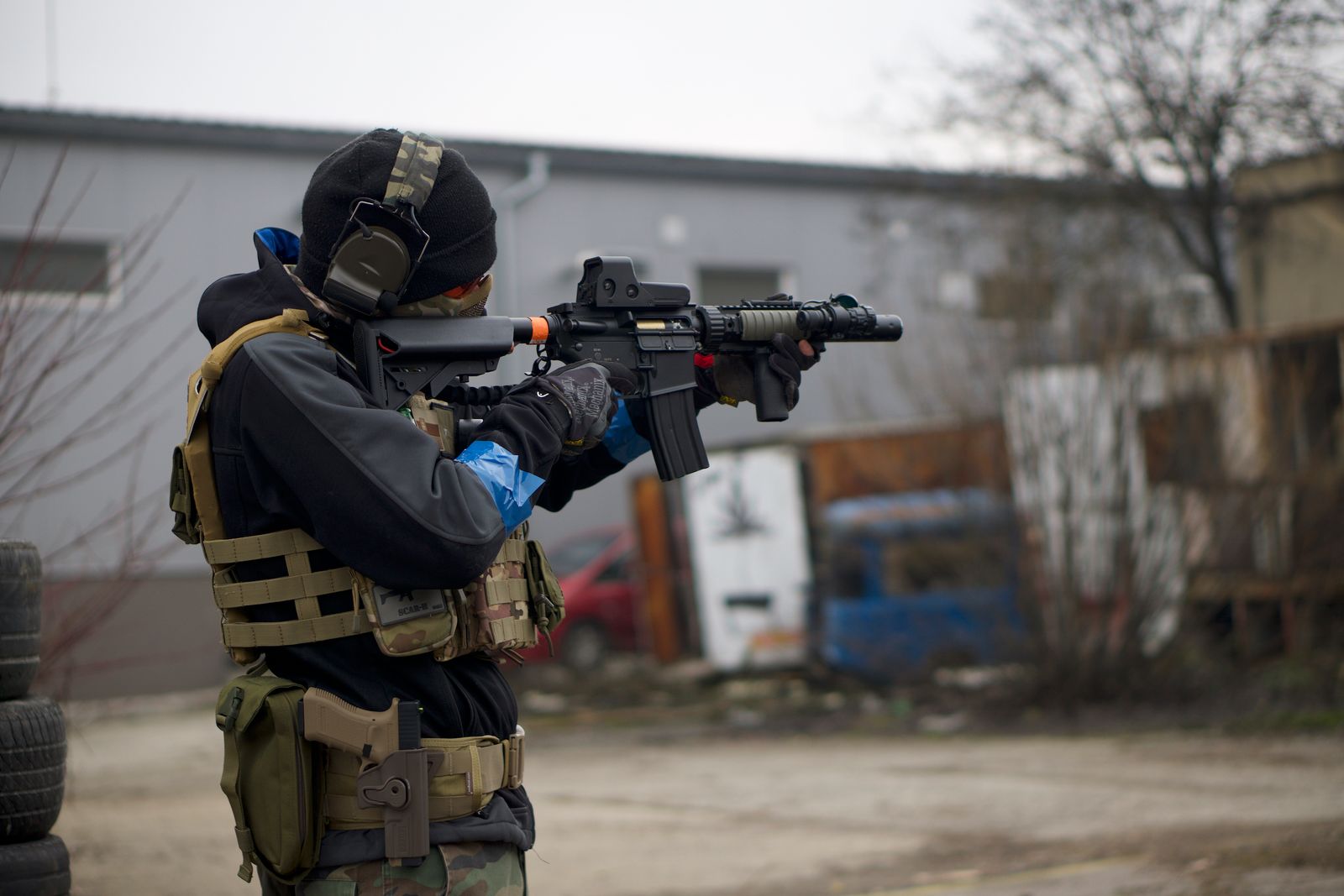
Getting hit by an airsoft BB stings. That is the honest answer, and anyone who tells you it doesn’t is trying to sell you something. But “stings” is a long way from “injures,” and the gap between those two words is where most beginners get the wrong idea.
A typical hit feels like a hard flick from a rubber band, or a sharp snap against the skin. It registers, it makes you flinch, and two seconds later you are usually fine. Most players stop noticing individual hits within their first game or two.
What follows is what actually determines how much it hurts, how airsoft compares to paintball, and what you can do about it.
What does an airsoft hit actually feel like?
On covered skin — a hoodie, a jersey, any normal layer of clothing — most hits are a dull thump you barely register in the middle of a game. Adrenaline does a lot of the work here.
On bare skin, it is sharper. A close-range hit to an exposed forearm or the back of the neck will sting properly for a few seconds and may leave a small red welt that fades within an hour or two. Occasionally a very close hit breaks the skin slightly, the way a hard scratch would.
The pain is brief. Unlike a bruise from a fall, an airsoft hit generally hurts most in the first second and fades fast. Players routinely take dozens of hits across a day’s play and go home with nothing but a few pink spots.
The exceptions worth knowing
- Point-blank hits hurt considerably more. This is why most fields enforce a minimum engagement distance and a “bang rule” that lets you call a surrender instead of shooting someone at arm’s length.
- Fingers, ears, and the back of the neck are the spots regulars complain about. Thin skin over bone, and rarely covered by gear.
- Sniper rifles hurt more per hit because they push heavier BBs at higher energy — but they fire far less often and almost always from a distance.
The four things that decide how much it hurts
1. FPS and joule output
FPS — feet per second — is the number everyone quotes, but on its own it is misleading. What actually matters is energy, measured in joules, which combines velocity with BB weight. A gun shooting light BBs fast can measure the same FPS as one shooting heavy BBs slower while hitting much softer.
Fields cap this for exactly this reason. Typical US limits look like:
| Gun type | Common field limit | Why |
|---|---|---|
| Indoor / CQB | ~350 FPS | Engagements are close, so energy is capped low |
| Outdoor AEG | ~400 FPS | Standard rifle limit at most outdoor fields |
| DMR | ~450–500 FPS | Paired with a minimum engagement distance |
| Bolt-action sniper | ~500–550 FPS | Highest cap, longest required distance |
These vary by field. Every field chronographs guns before play, and anything over the limit does not go on the field. That system is the main reason airsoft stays comfortable.
2. Distance
BBs lose energy quickly. A hit at 100 feet is a tap. The same gun at 10 feet is a genuine sting. This is the single biggest variable, and it is why minimum engagement distances exist — typically 10 to 20 feet for rifles and considerably more for high-FPS DMRs and snipers.
3. What you are wearing
A single layer of normal clothing absorbs most of the impact. Long sleeves, gloves, and a neck gaiter remove nearly all the discomfort that beginners complain about. Players who show up in shorts and a t-shirt are the ones who describe airsoft as painful.
4. BB weight
Heavier BBs (0.28g, 0.30g and up) carry more energy downrange and hit harder at distance, but they are also more accurate and more stable in wind. Lighter BBs (0.20g, 0.25g) shed energy faster. Most fields regulate by joules precisely so this trade-off stays fair.
Does airsoft hurt more than paintball?
No. Paintball hurts more per hit, and it is not particularly close.
A paintball is roughly 3 grams and about 17mm across. An airsoft BB is 0.20 to 0.30 grams and 6mm across. The paintball carries far more energy and spreads it over a wider area, which is why paintball welts are larger, darker, and last longer. Paintball players routinely finish a day with visible bruising; airsoft players usually do not.
Airsoft has two offsetting factors. First, volume — an AEG fires on full auto, so you will take more total hits in a day than you would playing paintball. Second, airsoft BBs are small enough to find gaps that a paintball cannot, which is why eye protection is non-negotiable.
| Airsoft | Paintball | |
|---|---|---|
| Projectile weight | 0.20–0.40g | ~3g |
| Pain per hit | Sharp sting, fades fast | Harder thump, often bruises |
| Hits per game | Higher | Lower |
| Marks left | Small red welts, hours | Larger bruises, days |
| Leaves paint on you | No | Yes |
The practical summary: paintball hurts more when you get hit, airsoft gets you hit more often. Most people who have played both describe airsoft as the more comfortable of the two.
Is airsoft actually dangerous?
Played with proper eye protection at a supervised field, airsoft is a low-injury sport. The serious risk is concentrated almost entirely in one place: your eyes.
A 6mm BB travelling at field-legal velocity can cause permanent eye injury. This is not a theoretical risk and it is not something experience protects you from. Every field in the country requires eye protection, requires it to stay on at all times inside the play area, and will remove you for lifting it.
What to actually wear
- ANSI Z87.1-rated eye protection, minimum. Regular sunglasses and prescription glasses are not rated for impact and can shatter. Sealed goggles beat shooting glasses because BBs can get around an open frame.
- Full-face or lower-face protection if you would rather keep all your teeth. Dental damage is the second most common serious airsoft injury, and a mesh lower mask solves it.
- Gloves. Hands are exposed constantly and finger hits are among the most unpleasant.
- Long sleeves and long trousers. The cheapest pain reduction available.
- A neck gaiter or shemagh. Covers the spot everyone complains about.
If you buy exactly one thing before your first game, buy sealed, rated goggles. Everything else is comfort.
Does airsoft hurt kids?
The physics do not change with age, but children have thinner skin and considerably less tolerance for the surprise of being hit. Most fields set a minimum age between 10 and 12 for this reason, often with lower FPS limits for junior games and mandatory full-face protection.
Plenty of younger players enjoy airsoft. The predictors of a good first experience are the same at any age: full-face protection, long sleeves, and a field that enforces engagement distances. We cover the specifics in our guide to how old you have to be to play airsoft.
The short version
Airsoft stings for a second and then it is over. Wear long sleeves, wear gloves, and wear sealed rated goggles you never take off inside the field. Do that and the pain is a non-issue within your first hour of play — which is roughly how long it takes most people to stop thinking about it entirely.
If you are weighing up your first setup, our guide to the best airsoft guns covers what to buy at each budget, and what is airsoft walks through how the sport actually works.
Frequently asked questions
Does airsoft hurt through clothes?
Much less. A single layer of normal clothing absorbs most of the impact, turning a sharp sting into a dull thump. Long sleeves and trousers are the simplest way to make airsoft comfortable.
Do airsoft guns leave bruises?
Occasionally, but small ones. Most hits leave a red mark that fades within an hour or two. Close-range hits to bare skin can leave a minor welt for a day. Deep bruising is uncommon at field-legal velocities.
Can an airsoft gun break skin?
At very close range against bare skin, yes — usually a small graze rather than a puncture. This is why fields enforce minimum engagement distances and surrender rules.
What hurts more, airsoft or paintball?
Paintball hurts more per hit. A paintball weighs roughly ten times what an airsoft BB does and delivers considerably more energy, which is why paintball leaves larger, longer-lasting bruises.
Is airsoft safe for a 12 year old?
At a supervised field with full-face protection and enforced FPS limits, generally yes — most fields set their minimum age around 10 to 12. Full-face protection matters more for younger players, not less.