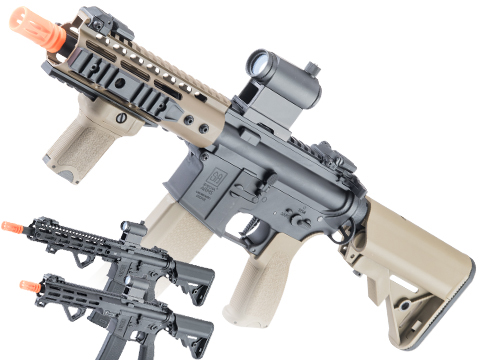
Specna Arms EDGE 2.0 Series M4 Airsoft AEG Rifle
- Rifle
- AEG (Electric)
- SKU AEG-SA-E12-2.0-HT
Opens an Amazon search — we do not track Amazon prices or stock, so check them there.
Price comparison
| Retailer | In stock | Price | Difference | Link |
|---|---|---|---|---|
| Evike.com Best price | No | $359.00 | — | View deal for $359.00 at Evike.com (opens in a new tab) |
Prices last checked 16 hours ago. Always confirm on the retailer site before buying.
Price history
- Lowest tracked $359.00
- Highest tracked $359.00
- Price changes recorded 3
Based only on prices we have observed since tracking began.
About this airsoft gun
The Specna Arms EDGE 2.0 is the Polish brand’s upper-middle rifle specification, and this M4 configuration is the plainest expression of it: a standard AR-15 silhouette, familiar controls, and a gearbox built to be programmed rather than immediately torn down. It is aimed at the player who has decided their next rifle should be the one they stop modifying.
What the Specna Arms EDGE 2.0 designation actually means
Specna Arms sorts its rifles into tiers rather than selling one gun at one spec. The entry line is built to a price. The PRIME series at the top runs brushless motors and second-generation electronics. EDGE 2.0 sits in between, and its reason for existing is to arrive with the internals a mid-tier player would otherwise buy separately in their first season with the gun.
In practice that means two things worth checking on the retailer listing before you order. First, the trigger: the EDGE line’s headline feature is a factory-fitted programmable electronic trigger unit, which replaces mechanical trigger contacts and brings burst modes, trigger response tuning and low-voltage protection out of the box. Confirm which unit is fitted to the configuration you are looking at: the series spans more than one generation of electronics. Second, the gearbox shell: EDGE-specification gearboxes are generally built for quick spring access, so power can be adjusted without a full strip. If you play somewhere with a hard velocity ceiling, confirm that on the listing before anything else on the spec sheet.
Everything else about the gun is deliberately conventional, and that is exactly what makes an M4 cheap to own.
The M4 platform is half of what you are buying
An AEG runs off a rechargeable battery driving a gearbox, which is why it is the default primary airsoft gun: consistent shot to shot, cheap to feed, and accepted at essentially every field. Choosing an M4 on top of that gets you the deepest parts ecosystem in the sport.
- Magazines. Standard AEG M4 magazines are the most abundant magazine type in airsoft, in mid-cap and hi-cap, from a dozen brands. You will never struggle to find spares.
- Furniture. AR-pattern pistol grips and stocks are interchangeable across the market. Swapping either is a screwdriver job, not a project.
- Optics. The flat-top receiver rail takes any standard mount, so a red dot or magnifier fits without an adapter.
- Handguard. Rail interface and length vary between configurations inside this series, so read the listing rather than assuming. It decides what accessories bolt on and, on many M4 AEGs, where the battery lives.
That last point catches people out. Check whether the battery sits in the stock tube or under the handguard, what connector the gun ships with, and what pack size will physically fit. Buying the wrong battery shape is the most common reason a new rifle sits in a bag for a week.
Internals and the upgrade path
M4-pattern AEGs are conventionally built around the Version 2 gearbox layout, which is the best-supported set of internals in airsoft: springs, pistons, cylinders and hop-up units are off-the-shelf items, and any competent technician has opened that layout hundreds of times. Confirm what your configuration actually runs on the listing. The airsoft gearbox guide covers what each component does before you start ordering parts.
What a factory electronic trigger changes is the order in which you spend money. On a mechanical gun, the first upgrade is usually a MOSFET, both to protect the trigger contacts and to sharpen response. Here that is settled already, which pushes the useful upgrades further down the list.
- A better hop-up bucking and nub, which does more for grouping than anything else you can buy.
- An inner barrel matched to how you actually play, rather than a longer one on principle.
- A spring change to land inside your field’s velocity limit, if the gun ships hotter or colder than you need it.
There is a trade-off worth being honest about. An electronically triggered gearbox is less forgiving than a mechanical one. It cares about battery chemistry, connector type and voltage, and about not being run flat repeatedly. Read the manual before you plug anything in, and do not assume a pack that worked in an older gun is appropriate here. Programming the fire modes follows a set procedure too, so keep the manual.
Who it suits, and who should look elsewhere
This is a second or third gun, not a first one. It suits the player who has done a season on an entry rifle, knows what annoys them about it, and wants a platform that will not need a technician to keep up. It also suits anyone who dislikes tinkering and would rather buy the internals once, already installed.
Look elsewhere if:
- You have never played. Rent first, then buy. The beginner buying guide explains why a first purchase should be simple and replaceable.
- You play indoor CQB almost exclusively. A full-length M4 is workable in tight buildings but clumsy, and a shorter platform is easier to fight with.
- You are planning an HPA conversion. Fitting an engine throws away the gearbox and electronics you paid for. Start from a plainer donor gun instead.
- You want a designated marksman build. This is a general-purpose rifle, and DMR money is better spent on barrel and hop-up from the outset.
Getting it field-ready
The rifle is one line on the shopping list. The rest of it:
- Eye protection. Non-negotiable and enforced at every field. Full-seal goggles or a mesh mask, and the eye protection guide covers what passes and what fogs.
- Battery and charger. Frequently not included. Match the pack to the manual’s specification rather than to whatever is cheapest.
- Spare magazines. Two or three mid-caps is the usual starting point for a full day of play.
- BBs. Weight changes range and wind behaviour more than most new players expect, and the BB weight guide explains how to choose.
Before you order, check the listed muzzle velocity against your home field’s limit. Fields turn guns away at the chrono, and a spring swap arranged in advance is far less annoying than a wasted Saturday.
Where it sits in the range, and whether it is the right buy
Inside the Specna Arms catalogue, the choice is mostly about form factor rather than quality. The SA-X01 EDGE 2.0 SMG puts comparable thinking into a much smaller package, which is the better answer for indoor sites and for anyone who finds a rifle-length gun unwieldy. The SA-E25 EDGE 2.0 RRA M4 SBR keeps M4 controls and magazine compatibility while shortening the whole gun, which is the sensible middle ground if you split your time between woodland and buildings. Step up to the PRIME series and you are paying for brushless drive and newer electronics, which is a genuine difference in trigger feel and a genuine jump in outlay.
The honest summary is that this rifle is not exciting and is not trying to be: a conventional M4 with the electronics argument settled at the factory, on the most-supported platform in airsoft. If your priority is a gun that works on day one and stays serviceable for years, that is the right set of compromises. If you enjoy building guns, you can reach a similar place by upgrading something plainer yourself.
Configurations within this series differ in handguard, length and electronics, so read the specification on the listing you are ordering from rather than assuming it matches another EDGE 2.0 you have seen. Check current availability at Evike, then use the retailer table above before you commit.