
Airsoft BB Weight Guide: Which BBs Should You Use?
0.25g suits most AEGs while snipers need 0.36g and up. How BB weight affects accuracy and FPS, why cheap BBs break guns, and what to buy.
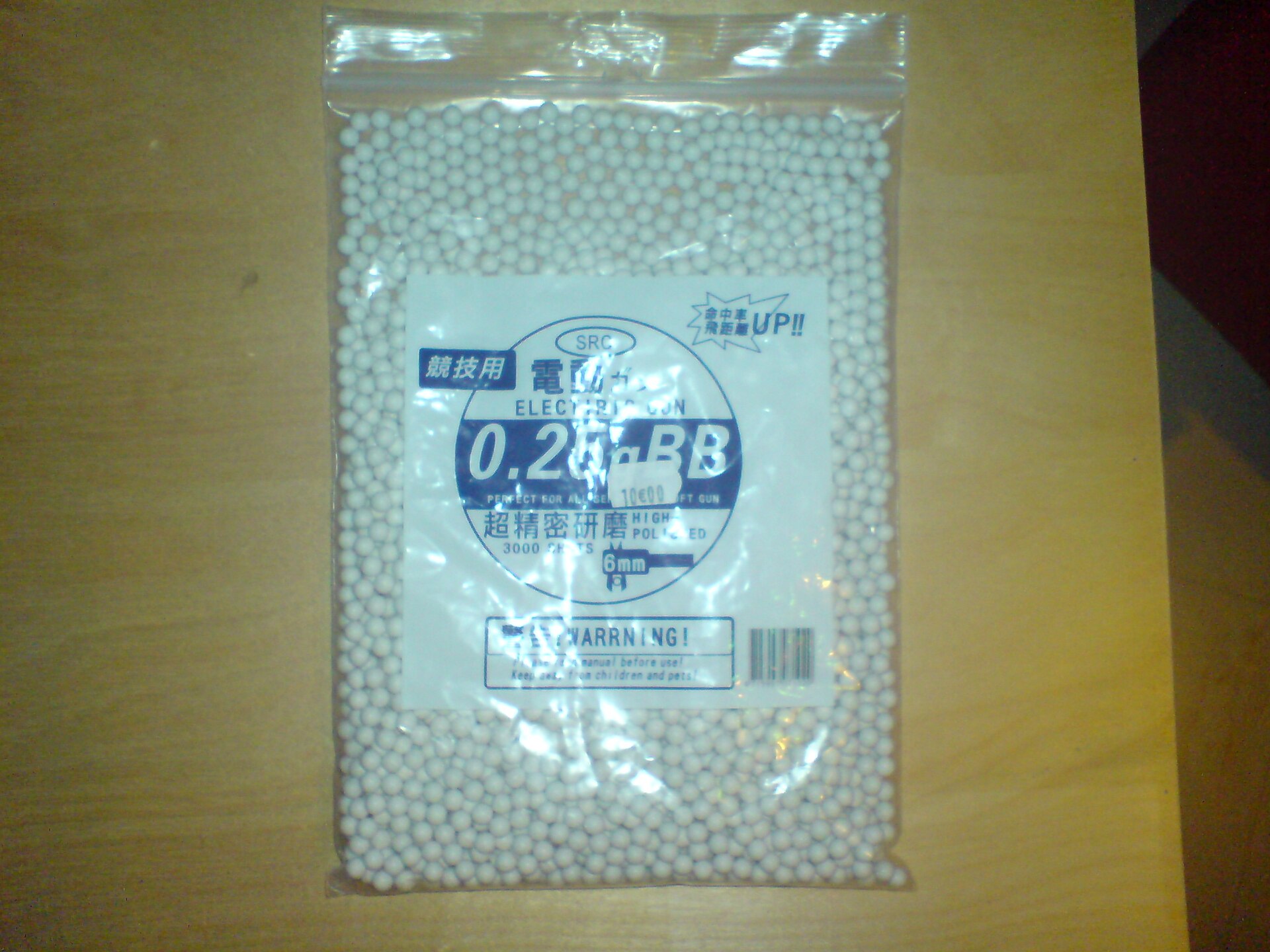
BBs are the cheapest part of airsoft and the one most likely to break your gun. A bag of bad BBs costs a few dollars and can cost you a barrel, a hop-up bucking, or an afternoon.
Two decisions matter: quality, where the answer is always “buy good ones,” and weight, where the right answer depends on your gun.
Weight at a glance
| Weight | Use for | Notes |
|---|---|---|
| 0.20g | Low-power guns, chrono testing | The reference weight FPS is quoted at. Light and wind-affected. |
| 0.25g | Most AEGs — the default | Best all-round balance. Start here. |
| 0.28g | AEGs, better range | Noticeably more stable than 0.25g outdoors. |
| 0.30–0.32g | Upgraded AEGs, DMRs | Strong outdoor choice if your hop-up can lift them. |
| 0.36–0.40g | DMRs and snipers | Needs a well-tuned hop-up. |
| 0.43–0.48g | Bolt-action snipers | Maximum stability at long range. |
If you are unsure: buy 0.25g. It suits nearly every stock AEG and is the safest default.
Why heavier BBs usually shoot better
Counterintuitively, heavier BBs are generally more accurate, despite leaving the barrel slower.
A heavier BB carries more momentum, so it is less affected by wind, less deflected by grass and twigs, and holds a straighter line further downrange. It also interacts more predictably with the hop-up — the backspin that gives a BB lift.
The trade-off is that heavier BBs need a hop-up capable of spinning them properly. Push too heavy for your setup and the BB drops early instead of flying flat. That is the practical ceiling on weight, not the gun’s power.
FPS, joules and why heavier BBs are not “more powerful”
Field limits are usually quoted in FPS measured with 0.20g BBs, because velocity alone is meaningless without a weight reference. What actually matters is energy in joules.
The same gun firing heavier BBs produces lower FPS but similar energy. This is why chronograph readings must specify weight, and why some fields chrono with their own BBs rather than yours.
Using heavier BBs does not get you around an FPS limit — a field measuring in joules will catch it immediately.
BB quality: what actually matters
Cheap BBs are the leading cause of avoidable airsoft repairs. What separates good from bad:
- Seam lines. Cheap BBs have a visible moulding seam. That ridge scrapes the barrel and hop-up rubber, degrading accuracy and eventually damaging parts.
- Diameter consistency. Good BBs hold tight tolerance. Inconsistent ones jam, or fly unpredictably.
- Surface finish. Polished BBs travel cleanly. Rough ones abrade the bucking.
- No air bubbles. Internal voids make weight inconsistent and can shatter the BB in the gearbox.
Never use the clear plastic BBs sold in big-box stores. These are the classic gun-killers — heavy seams, poor tolerance, and prone to shattering inside the hop-up.
Biodegradable BBs
Made from a plant-based plastic that breaks down over time. Many outdoor fields now require them, and a growing number of indoor ones do too.
Worth knowing: quality bio BBs perform indistinguishably from standard ones. Cheap bio BBs are noticeably worse, being more brittle and more prone to shattering. Biodegradability also means shelf life — store them dry and do not stockpile years in advance.
Check your field’s policy before buying in bulk. Turning up with non-bio BBs at a bio-only field means buying theirs at their price.
What to buy for your setup
- Stock AEG, indoor CQB: 0.25g
- Stock AEG, outdoor: 0.25g or 0.28g
- Upgraded AEG or DMR: 0.30g to 0.36g
- Bolt-action sniper: 0.36g to 0.45g — see our sniper guide
- Gas pistol: 0.25g — heavier BBs often struggle in pistol hop-ups
- Shotgun: 0.25g — see our shotgun guide
Testing for yourself
Buy a small bag of the next weight up and shoot both at a target 100 feet out. If the heavier BB groups tighter and flies flatter, your hop-up can handle it. If it drops off early, you have found your ceiling.
Storage
Keep BBs sealed, dry and away from heat. Moisture is the main enemy — damp BBs swell slightly and jam, and this is especially true of biodegradables. Loose BBs rolling around a bag pick up grit, and grit in a hop-up is how barrels get scratched. Keep them in a sealed container or a speedloader.
Building a first setup? See our beginner guide.
Why hop-up decides your BB weight
The reason you cannot simply fit the heaviest BB you can find comes down to one component: the hop-up bucking.
Hop-up puts backspin on the BB. That spin generates lift, which is what flattens the trajectory and gives you range. A heavier BB needs more spin to be lifted the same amount — and a stock bucking can only apply so much before it starts slipping or over-hopping.
What that means in practice:
- Too light for your setup: the BB over-hops, climbing before it falls off sharply. You will see rounds arcing upward.
- Correctly matched: a long flat line, then a gentle drop.
- Too heavy for your setup: the BB drops early because the hop cannot lift it. Range gets shorter, not longer.
So the ceiling on BB weight is set by your bucking, not by your gun’s power. A stock AEG with a good bucking will out-range a stronger AEG with a poor one.
Finding your ceiling
Buy a small bag of the next weight up and shoot both at a target roughly 100 feet out with the hop adjusted for each. If the heavier BB groups tighter and flies flatter, your setup can take it. If it drops off early no matter how you adjust the hop, you have found the limit — upgrade the bucking before going heavier.
A tracer unit makes this dramatically easier, because you can actually see the trajectory rather than infer it.
FPS, joules and why the chronograph reading changes
This trips up nearly everyone at their first chrono.
Energy is what fields regulate, and energy stays roughly constant for a given gun regardless of BB weight. Velocity does not. Fire a heavier BB and the same gun produces a lower FPS reading while delivering similar energy downrange.
| BB weight | Approx. FPS at ~1.3 joules | What it means |
|---|---|---|
| 0.20g | ~375 FPS | The reference weight limits are quoted in |
| 0.25g | ~335 FPS | Same energy, lower number |
| 0.30g | ~305 FPS | Same energy again |
| 0.40g | ~265 FPS | Looks far weaker; is not |
Two consequences worth knowing. First, using heavy BBs does not get you around an FPS limit — any field measuring joules will catch it instantly, and most now do. Second, if a field chronographs with its own 0.20g BBs and you normally shoot 0.30g, expect a higher reading than you are used to. That is normal.
Bio BBs in more detail
Biodegradable BBs are made from plant-derived plastics that break down over months to years depending on conditions. Many outdoor fields now mandate them, and an increasing number of indoor sites do too.
| Quality bio | Cheap bio | Standard plastic | |
|---|---|---|---|
| Accuracy | Indistinguishable | Noticeably worse | Baseline |
| Brittleness | Comparable | Shatters more | Baseline |
| Shelf life | Limited — store dry | Short | Effectively indefinite |
| Field acceptance | Universal | Universal | Increasingly restricted |
The important caveat is shelf life. Bio BBs begin degrading from manufacture, and a bag that has sat in a damp garage for two years will shatter in your gearbox. Buy what you will use in a season and store it sealed.
How to spot a bad batch before it costs you
Tip a few onto a flat surface and look closely:
- Visible seam line? Reject. That ridge scrapes your bucking and barrel every shot.
- Do they all roll the same? Wobble means out-of-round.
- Dull or chalky surface? Poor finish abrades rubber.
- White specks or visible bubbles? Internal voids — these are the ones that shatter in the gearbox.
- Do they feel gritty? Residue from moulding, which goes straight into your hop-up.
A shattered BB inside a gearbox is not a trivial problem — fragments jam the nozzle and score the cylinder. That is a repair costing many times what the BBs saved, and it is covered in our gearbox guide.
Quantities and cost
A typical player fires somewhere between 500 and 2,000 rounds in a day, depending heavily on whether they run full auto. A bag of 3,000–5,000 covers several outings for most people, and considerably fewer if you are feeding a support weapon.
BBs are the cheapest consumable in airsoft by a wide margin — cheaper per game than gas, field fees or travel. It is genuinely the last place to economise, which is why every experienced player says the same thing about the bargain bags.
Frequently asked questions
What BB weight should I use for airsoft?
0.25g suits most stock AEGs and is the safest default. Upgraded rifles and DMRs do better with 0.30g to 0.36g, and bolt-action snipers typically use 0.36g to 0.45g.
Are heavier airsoft BBs more accurate?
Generally yes. Heavier BBs resist wind and light obstructions better and hold a straighter line downrange, provided your hop-up can apply enough backspin to lift them.
Do heavier BBs increase FPS?
No, the opposite — heavier BBs leave the barrel slower while carrying similar energy. FPS is normally quoted using 0.20g BBs, which is why a chronograph reading is meaningless without a stated BB weight.
Are biodegradable airsoft BBs worth it?
Quality biodegradable BBs perform essentially identically to standard ones, and many outdoor fields now require them. Cheap bio BBs are more brittle and prone to shattering, so buy a reputable brand.
Why should I avoid cheap airsoft BBs?
Cheap BBs have visible seams, inconsistent diameters and internal air bubbles. They scratch barrels, wear hop-up buckings and can shatter inside the gearbox, costing far more in repairs than they save.